

The easiest way to eat kimchi is a spoonful at a time, added to meals you already enjoy, like eggs, rice, chapati or a side of nyama choma. Start with one or two tablespoons a day and build up slowly, because it’s salty. Serve it cold or at room temperature, and add it after cooking so the live cultures survive. Keep the jar in the fridge with the lid tight, and use a clean spoon each time. Research suggests fermented foods like kimchi may support a more diverse gut microbiome, though no single food does the job on its own.

Be honest: there’s a jar in your fridge that’s been sitting there since last month. You opened it once, loved the tang, then forgot what to do with it next.
You’re not alone, and the jar isn’t asking for much. This fermented food is mostly vegetables, so it fits easily next to the meals you already cook. Here’s how to work it into your week.
How Much Kimchi Should I Eat?
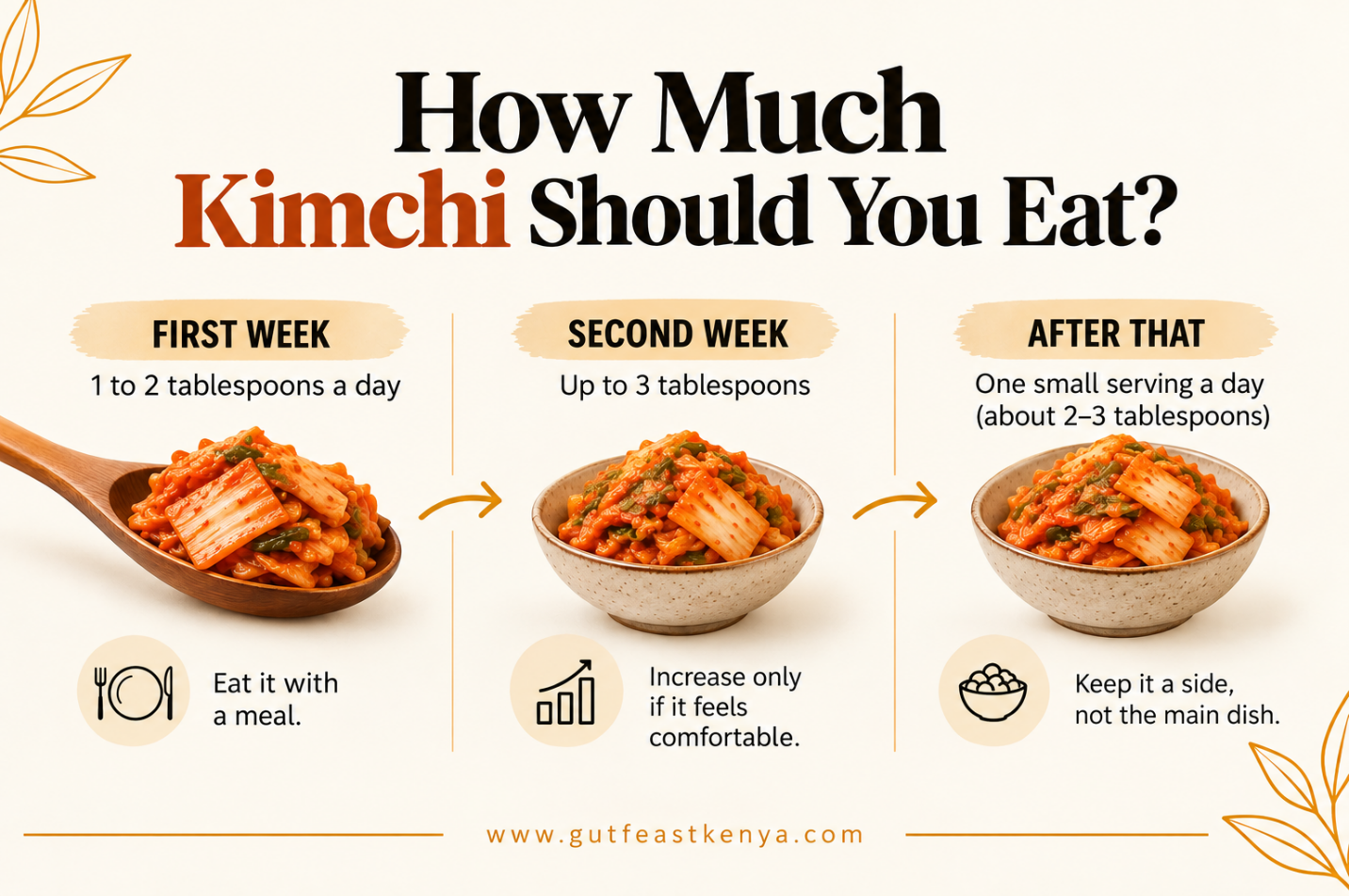
Start with one or two tablespoons alongside a meal and see how you feel. Pole pole. It’s smart to introduce any new food slowly, and this one is tangy, spicy and salty.
There’s no official daily amount, but here’s a sense of scale. In a large Korean study, one serving of cabbage kimchi was just under 2 ounces, roughly 50 grams or a few tablespoons (HealthDay).
| When | How much | Tip |
| First week | 1 to 2 tablespoons a day | Eat it with a meal |
| Second week | Up to 3 tablespoons | Add a second meal if you feel fine |
| After that | One small serving a day | Keep it a side, not the main dish |
Watch the salt. The study’s researchers recommend moderation because kimchi is a major source of sodium. The WHO advises adults to keep total salt under 5 grams a day, just under a teaspoon (WHO). If your stomach complains, ease off and try again with less.
How to Eat Kimchi: Easy Ideas for Kenyan Meals
You don’t need a Korean menu. Think of it as kachumbari with attitude: a tangy, crunchy side that wakes up whatever’s on your plate.
| Meal | How to add it | Why it works |
| Eggs or an omelette | Spoon it on top, or fold it in at the end | The tang cuts through the richness |
| Rice, pilau or githeri | Stir a spoonful in once the dish is off the heat | A quick flavour lift for leftovers |
| Chapati wrap | Roll it in with eggs, avocado or beans | Crunch inside a soft chapati |
| Ugali with sukuma wiki or fish | Serve a small side next to the greens | Sour and spicy against plain, filling food |
| Nyama choma | Put a bowl on the table next to the kachumbari | A fresh, tangy side for rich meat |
| Fries or avocado toast | Top with a spoonful | An easy upgrade for a quick snack |
One serving tip: heat kills live microorganisms. For live cultures, add it after cooking and don’t let it simmer. Cooked kimchi still tastes great, it just won’t be live.
What are the Benefits of Eating Kimchi?
Kimchi is a fermented food made from vegetables like cabbage or radish. Gut Feast’s version is naturally fermented and unpasteurised, so the microorganisms stay alive. That makes it a probiotic food you can add to everyday meals.
Here’s what research suggests. In a 10-week Stanford trial of 36 healthy adults, people who ate more fermented foods, including kimchi, yoghurt, kefir and kombucha, had more diverse gut microbes and lower levels of 19 inflammatory proteins. Larger servings had a stronger effect on diversity (Stanford Medicine).
It was a small study, and kimchi was one of several foods, so it can’t tell us what this ferment does on its own. The vegetables also bring fibre, which feeds the microbes already living in your gut.
No single food fixes gut health. Variety, fibre, sleep and movement all count, and this is one tasty part of that picture.
A 5-Minute Kimchi Recipe
This is the one to start with. It serves one.
You need: 2 or 3 eggs, 2 tablespoons chopped kimchi, a little oil or butter, pepper, and dhania to finish.
- Beat the eggs with pepper. Skip the salt, because it already has plenty.
- Heat the oil in a pan over medium heat and pour in the eggs.
- When the eggs are almost set, take the pan off the heat.
- Spoon the kimchi onto one half, fold the omelette over, and sprinkle dhania on top.
- Serve with chapati or toast.
Putting it on at the end keeps it raw, so the cultures stay alive.
How to Store Kimchi
Store kimchi in the fridge with the lid shut tight, keep the vegetables pressed under the brine.
- Use a clean spoon every time. Dirty utensils bring in unwanted microbes.
- Press the vegetables back under the brine after you scoop.
- Expect it to get tangier with time. It keeps fermenting slowly in the cold.
- A few bubbles are normal, so open the lid slowly.
- Throw it out if you see mould or smell something foul.
Key Takeaways
- Start small. One or two tablespoons with a meal is plenty at first.
- Add it to food you already love. Eggs, rice, chapati, ugali and nyama choma all work.
- Add it after cooking. Heat kills live cultures.
- Keep it cold. The fridge, a clean spoon and a tight lid do the job.
- Mind the salt. It counts toward your daily total.
Where to Buy Kimchi in Kenya
Gut Feast Kenya is based in Nairobi and delivers countrywide. Order our naturally fermented kimchi online, or contact us to arrange delivery to your town.
Frequently Asked Questions
What is the best way to eat kimchi?
As a side or a topping, added to meals you already enjoy. Eggs, rice and chapati are easy places to start. Add it after cooking to keep the live cultures.
Can I eat kimchi every day?
Many people do. Start small, keep an eye on the salt, and let how you feel guide you. If you have high blood pressure or another health condition, check with your doctor first.
Should I eat it on an empty stomach?
Most people find spicy, salty foods easier with a meal, so that’s a good default.
Does cooking kill the live cultures?
Yes. Heat kills live microorganisms, so cooked dishes won’t be live. They still taste great, but for live cultures, add it at the end.
Sources
- Stanford Medicine: fermented-food diet increases microbiome diversity
- HealthDay: a Korean study on kimchi servings, published in BMJ Open
- WHO: salt reduction fact sheet
Fermented foods suit most people, but check with your doctor if you are pregnant, immunocompromised, taking an MAOI antidepressant or managing a health condition such as high blood pressure.