

The easiest way to eat sauerkraut is as a tangy side, one or two spoonfuls next to something rich, starchy or grilled, like fried fish, ugali or nyama choma. Serve it cold or at room temperature, and add it after cooking so the live cultures survive. Start small and build up slowly, because it’s salty. Keep the jar in the fridge with the cabbage under the brine, and use a clean spoon each time. Choose raw, unpasteurised sauerkraut if you want live cultures.

Kenyans already know how to eat cabbage. Kabichi sits beside the ugali on many plates, fried with onions and tomatoes. Sauerkraut is the same vegetable with one twist: it has been fermented. Here’s how to eat sauerkraut so it feels like a natural part of your plate, not a science project.
| At a glance | The short version |
| Taste | Tangy and sour, with a little salt |
| Texture | Soft, with a bit of crunch |
| Best first spoonful | One tablespoon next to something rich, like fried fish or sausage |
| How to serve it | Cold or at room temperature, straight from the jar |
What Is Sauerkraut?
It’s shredded cabbage fermented with salt, and nothing else is needed. The salt draws out the cabbage’s own juice, and natural bacteria on the leaves turn its sugars into lactic acid. That acid gives the tang and keeps the cabbage fresh (University of Wisconsin-Extension).
That’s why fermented cabbage and vinegar-pickled cabbage are different things. One is sour because it fermented. The other is simply soaked in acid.
If you want live cultures, read the label. Look for "raw", "unpasteurised" or "live cultures", and expect to find the jar in the fridge. Heat-treated jars on a dry shelf won’t be live. Gut Feast’s version is naturally fermented and unpasteurised, so the microorganisms stay alive. That makes it a probiotic food.
How to Eat Sauerkraut
The trick is contrast. Sauerkraut is sour and crunchy, so it loves anything rich, plain or fatty. Use this guide to match it with what’s already on your plate.
| If your plate has | Add it because | Try it with |
| Something rich or fried | The sourness cuts through the fat | Fried fish, smokie pasua, chips |
| Something grilled | It adds a fresh, tangy crunch | Nyama choma, grilled chicken, sausages |
| Something starchy | It wakes up plain, filling food | Ugali, rice, boiled potatoes, chapati |
| Something soft or mild | It adds bite and flavour | Scrambled eggs, beans, ndengu |
| Something fresh | It works as kachumbari’s sour cousin | Avocado, tomato salad, kachumbari |
A simple rule: two tablespoons beside the main dish, never piled over it.
Three Quick Sauerkraut Recipes (No Cooking Needed)
Each takes under five minutes and needs no stove, so the cultures stay alive.
- Kraut and avocado chapati roll. Warm a chapati, spread mashed avocado, add a spoonful of sauerkraut and a squeeze of lemon. Roll it up and eat.
- Smokie with a kraut topping. Slice a cooked smokie, then pile on sauerkraut, chopped tomato and onion. Add pilipili if you like heat.
- Quick kraut slaw. Mix a few tablespoons with grated carrot, a spoon of plain yoghurt and black pepper. Serve beside rice or ugali.
Hot food is fine to enjoy, but heat kills live microorganisms. Add the sauerkraut once the food is off the heat.
Serving Tips
- How much: start with one or two tablespoons beside a meal. Build up slowly if it agrees with you.
- How to serve it: straight from the fridge or at room temperature. Skip the pan if you want live cultures.
- Rinse or not: rinsing in cold water makes it milder and removes some salt. If you love the tang, leave it as it is.
- Mind the salt: one extension guide puts typical sauerkraut at about 1.5 grams of sodium per cup. The WHO advises adults to keep total salt under 5 grams a day (WHO), so count it as part of your day’s salt.
How to Store Sauerkraut
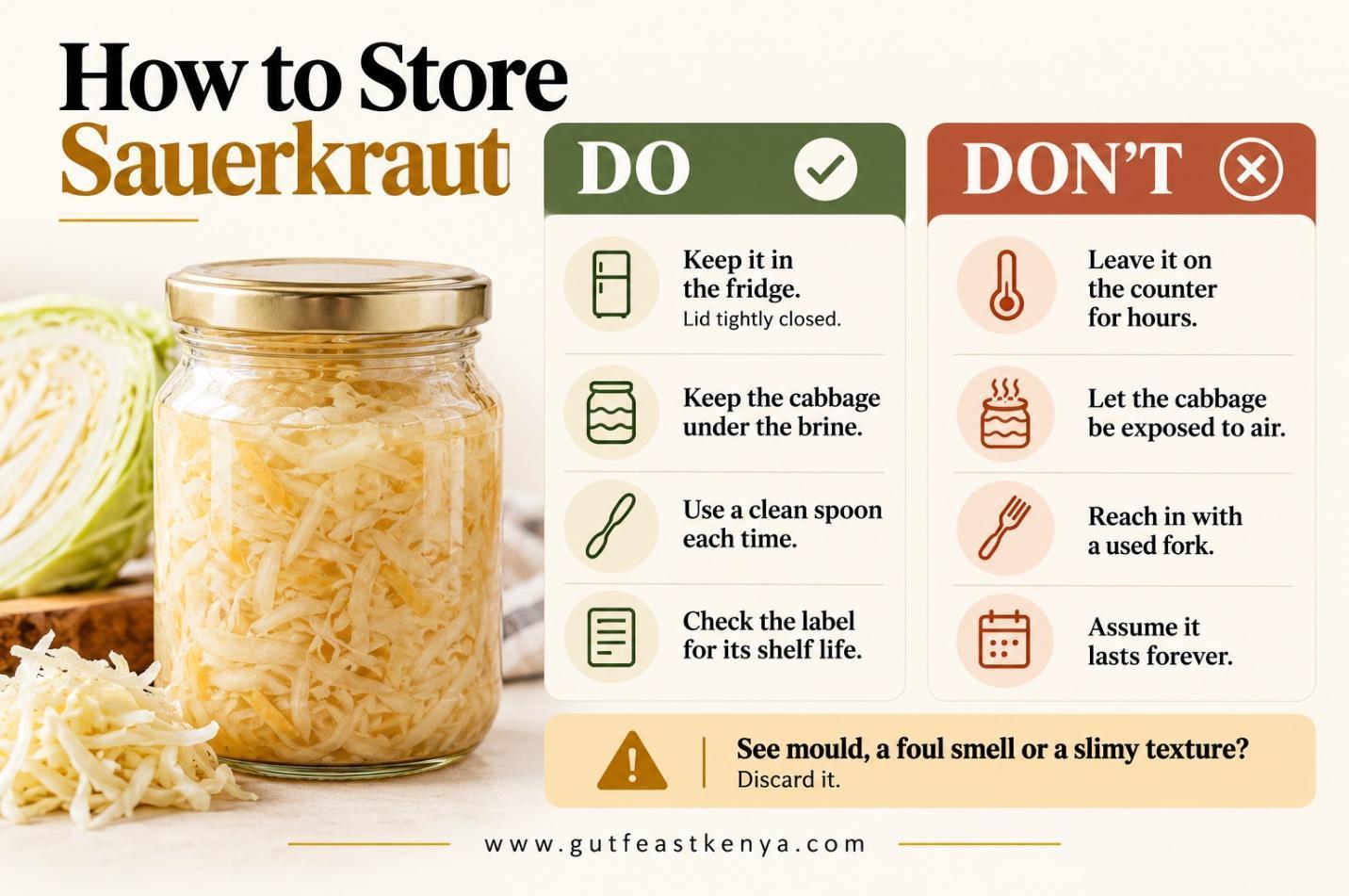
Fully fermented sauerkraut can keep in the fridge for several months when the jar is tightly closed (University of Wisconsin-Extension). Your jar’s label has the exact shelf life.
| Do | Don’t |
| Keep the jar in the fridge, lid tight | Leave it on the counter for hours |
| Keep the cabbage under the brine | Leave it exposed to air |
| Use a clean spoon each time | Reach in with a used fork |
| Check the label for its shelf life | Assume it lasts forever |
| Bin it if you see mould, a foul smell or a slimy texture | Scrape off mould and eat the rest |
Sauerkraut Benefits
Sauerkraut is low in calories and a good source of vitamin C, with about 30 milligrams per cup (University of Wisconsin-Extension). The cabbage also brings fibre, which feeds the microbes already living in your gut.
Research on sauerkraut is promising. In a pilot study of 34 people with irritable bowel syndrome, eating sauerkraut daily for six weeks changed their gut bacteria and was linked to milder symptoms (Food & Function). The study was too small to be conclusive, and the authors suggested the cabbage’s fibre may have mattered as much as the live bacteria.
The wider picture is encouraging too. In a Stanford trial, people who ate more fermented foods, including kimchi and other fermented vegetables, had more diverse gut microbes.
No single food does the job. Variety, fibre, sleep and movement all count, and this is one tasty part of that picture.
The Quick Cheat Sheet
| Question | Short answer |
| How much to start with | One or two tablespoons beside a meal |
| Best partners | Rich, fried, grilled or starchy foods |
| Hot or cold | Cold or room temperature, added after cooking |
| Where to keep it | In the fridge, under the brine, with a clean spoon |
| Watch out for | The salt, and mould or a foul smell |
Where to Buy Sauerkraut in Kenya
Gut Feast Kenya is based in Nairobi and delivers countrywide. Order our naturally fermented sauerkraut online, or contact us to arrange delivery to your town.
Frequently Asked Questions
Do I need to rinse sauerkraut before eating it?
No, but you can. Rinsing in cold water makes it milder and removes some salt. If you love the tang, skip it.
What’s the difference between sauerkraut and kimchi?
Both are fermented vegetables. Sauerkraut is cabbage and salt, with a clean, sour taste. Kimchi usually adds seasonings like chilli, garlic and ginger, so it tastes bolder.
How much sauerkraut should I eat a day?
There’s no official amount, so start small. One pilot study had people eat 75 grams a day for six weeks, but that’s not a target for everyone.
Who should be careful with sauerkraut?
It’s high in salt, so watch your portions if you’re managing blood pressure. It’s also high in tyramine, so if you take an MAOI antidepressant, avoid it unless your doctor says otherwise (Mayo Clinic).
Sources
- University of Wisconsin-Extension: Make Your Own Sauerkraut
- Food & Function: sauerkraut and IBS pilot study
- Stanford Medicine: fermented-food diet and microbiome diversity
- WHO: salt reduction fact sheet
- Mayo Clinic: MAOIs and tyramine
Fermented foods suit most people, but check with your doctor if you are pregnant, immunocompromised, taking an MAOI antidepressant or managing a health condition.